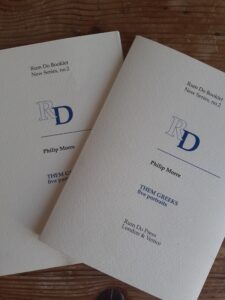
THEM GREEKS
This is a lecture I gave – probably in 2018 – at the Circolo Italo-Britannico in Venice,
after publishing my pamphlet Them Greeks
I don’t know if many of you read poetry: few people do, recreationally, as it were, so I
am going to talk mainly about the Greeks, or ‘Greeks’ in inverted commas, that the
poems are about, rather than the poems themselves, but I won’t be able to resist
reading a couple of them. Greeks in inverted commas, because in fact none of these
characters was born in mainland Greece – though Hippocrates may have died there
– but they all came from somewhere in the Greek-speaking world. As to the title, I
just preferred the sound of Them Greeks (grammar go hang) to Those Greeks.
As I am sure you know, there was never anything that could be described a
‘Greek empire’, or even a unified Greece, for most of antiquity, although a number of
the city states had colonies in Asia Minor and, of course, in Southern Italy – Magna
Graecia – the one exception being the vast blink-and-you’ll-miss-it empire of
Alexander the Great.
Alexander crossed the Hellespont to take on the Persian Empire in 334 BC,
reached India, carrying all before him, in 326, and died in June 323: 11 years in all,
after which everything almost immediately fell apart. That process, the falling apart, is
a particularly confusing and – to me at least – fascinating period. If you are not
prepared yourselves to soldier through, say, Peter Green’s Alexander to Actium (the
notes alone run to 150 pages). I can recommend a more entertaining handle on the
wars of those years, not to mention the many murders (including those of
Alexander’s half-brother Philip Arrhidaeus – who was not the full drachma, so to
speak, but was set up as a puppet king for a while – his Cruella de Vil mother
Olympias, who reputedly slept with snakes, his Bactrian wife Roxana and their infant,
posthumously-born son, another Alexander): Mary Renault’s Funeral Games.
My favourite character in that mess is Ptolemy, one of Alexander’s closest friends,
possibly (but probably not) his half-brother, who sensibly got out of the way of the
squabbling successors – the diadochoi, as they are known – took the midnight train
to Memphis and grabbed Egypt, which his descendants kept until Cleopatra and
Anthony were sunk at Actium in 31 BC. Until quite recently I was persuaded that
Ptolemy had been memorably played in some blockbuster by Peter Ustinov (a
memorable non-memory).
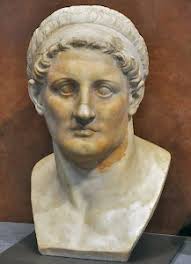
Ptolemy Soter
Ptolemy and his son Ptolemy Philadelphus (‘sister-lover’ – he married his,
Arsinoe, in seconde nozze) set up a brilliant court at Alexandria, and famously
established the greatest library of the ancient world there. I am finally getting to the
point, the first point – that there worked the poet Callimachus, originally from Cyrene
along the coast in what is now Libya.
Callimachus is sometimes said to have been, but was apparently not, the head
librarian, but might well have been the deputy of some placeman who smoked cigars
all day in his office while others did the work. He is known to have made a 120-
volume (more plausibly a 120-scroll) catalogue of the library’s holdings, and
produced a huge quantity of works (some 800 titles, so the story goes: all, or nearly
all, lost) on a wide variety of subjects, including, for example, On Birds, On Nymphs,
The Rivers of Europe, The Customs of the Barbarians and, intriguingly, Local Month
Names. He is also, more relevantly, by far the most celebrated poet of the Hellenistic
age. His byword was brevity, and, rather like Calvino, levity, or at least leggerezza,
and his motto was mega biblion mega kakon, which has been mischievously
translated as “big book, load of …ordure”, though every schoolboy knows that kakon
is simply the Greek for a bad thing. Every schoolboy also used to know, or was
beaten until he did know, a famous poem on the poet’s friend Heraclitus, as
translated into rather pretty Victorian verse by William Johnson Cory:
They told me Heraclitus, they told me you were dead,
They brought me bitter news to hear and bitter tears to shed.
I wept as I remembered how often you and I
Had tired the sun with talking and sent him down the sky.
And now that thou art lying, my dear old Carian guest,
A handful of grey ashes, long, long ago at rest,
Still are thy pleasant voices, they nightingales, awake;
For death, he taketh all away, but them he cannot take.
Which is actually a fairly faithful rendering of the sense – if not the tone or
concision of the original. Unlike my own translations, or mistranslations. There would
not be much excuse for misrepresenting the unfortunate Alexandrian had he not
been so frequently – and accurately – translated by all and sundry down the
centuries, from Catullus to Stephanie (formerly Stephen) Burt. I do try to get
everything in that’s there in the original, but then jazz it up a bit with spurious details.
Here is a brief example of what I mean:
The staid and reliable Loeb Classics of this one goes
At morn we buried Melanippus; as the sun set, the maiden Basilo died by her own hand; for
she could not endure to lay her brother on the pyre and live; and the house of their father
Aristippus beheld a twofold woe; and all Cyrene bowed her head to see the home of the
happy children made desolate.
Mine is less …soppy:
Melanippus, who sold smack to schoolkids,
did the world a favour this morning,
dying from a seizure. Young Basha
followed after lunch by her own hand.
Having laid out her brother it seems
she lay down herself and saw no reason
to get up again. Their fond father’s
vacant house is crushed on two sides
like a nut. We are sorry for him,
up to a point. Had he no warning?
One thing he must know only too well:
both his darlings are ticketed to hell.
I don’t know what came over me.
In my vanity, I thought I was the first to do something like this, but I soon found
that the (late) Australian poet John Tranter had been at it before me, and sometimes
with the very same poems. You may in any case think that there’s not a lot of point to
it all, and it’s hard to disagree, but pointfulness isn’t everything.
The second of my Greeks, and the Greekest of them, you might say, is
Hippocrates. Of course, as is often the case with personalities from the Ancient
World (he was born around 360BC), very little is known for certain: biographies tend
to be full of “He must have” and “Most likely he…” etc.
Most likely he studied at the Asclepieion in his native Kos – part medical school
and part healing temple, where the sick bunked down in the sanctuary to be visited in
dreams, and hopefully cured – or told how to cure themselves – by the god Asclepius
himself. There was also a possibly more practical emphasis on healthy diet, exercise
and hygiene. The successfully cured left grateful testimonial behind them, which
those who died were in no position to contradict. I believe this is called ‘survival bias’.
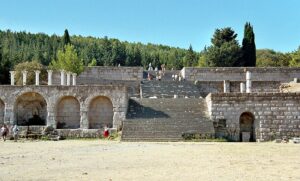
(What is left of) the Kos Asclepieion
father and grandfather, who were reputedly physicians themselves, or at the
ascelpieion, at least to the extent that he would himself be a keen promoter of
healthy lifestyles – two and a half thousand years before the Gloopmeisterin.
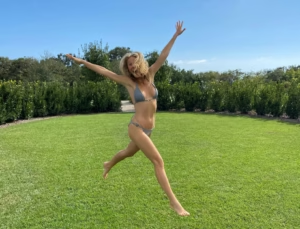
Gwyneth Paltrow
He was one of the first to ascribe sickness to natural causes rather than the
spitefulness of the gods. He also made some genuine diagnostic advances and
pioneered techniques for the treatment of haemorrhoids that are still used. He left
behind a miscellaneous collection of medical works known as the Hippocratic Corpus
(not to mention the Hippocratic oath, versions of which are still sworn by doctors
today9. In reality, that collection is certainly by different hands, and written at different
times. One of the problems here is that respect for established eminence was so
strong in the ancient world that anyone coming after, if they wanted to be taken
seriously, would ascribe their brilliant breakthroughs to some great predecessor: “As
Hippocrates used to say…”, when he had not in fact said anything of the sort. For all
that, it may well be that the Hippocratic Corpus does broadly represent Hippocrates’
approach.
Later in life he appears to have moved to mainland Greece and may have set up
an asclepieion, of his own in Larissa, Thessaly – where again he may have died at a
considerable age. The fact is that just about everything that is known about him, or
supposed, was written down much later and could quite easily have been fiction.
This is my Hippocrates poem. It is dedicated to Dennis Linder, a dermatologist here
in Venice, who is a member of the Hippocrates Society, a quixotic enterprise
promoting poetry and medicine, of medicine in poetry. I entered my poem in their
generously funded annual prize for medical poetry, which inexplicably it didn’t win. It
may not have been quite what they were after – the winners, I have since found, are
liable to be gruelling but uplifting personal verses about surviving – or not surviving –
bowel cancer. It is also possible, of course, that they simply didn’t like it. I should
warn you that it turns to some extent on an infantile pun on ‘Hippo’ and ‘crates’ which
I ascribe to the students (it wouldn’t have worked in Greek anyway, of course).
Snapshot of Hippo with Bananas
for Dennis Linder
He said often he always loved teaching,
loved, in fact, young things (nothing untoward
you understand), their bare tanned arms,
the social gradations of their pens and sneakers . . .
And he thought, rightly, that they loved him back.
"When I was at the asclepieion,," he would say,
"in Kos, a student like yourselves . . ." and before long
the whole class, seeing it coming, would chant as one:
"in Kos, a student like ourselves", and he was chuffed
at the warmth behind the mockery. Which of us
is not, in old age, a parody of himself?
And who does not believe the hippo a benign
creature? His best draughtswoman, a decade ago,
made a picture of the 'potamus astride a tor
of banana crates (such as you might find
discarded behind the market at noon),
which was pinned ever after over the door.
“Do pachyderms eat plantains?” He was always
trying to push back the limits of knowledge.
His one fear was, paradoxically, that
he had done too well, not for himself – fame
in fickle times is a passport of sorts –
but for them. They hung on his words so,
refused to query, to challenge. He imagined
his star pupil, a lifetime on, giving the same
identical lecture: "When I was at the asclepieion,
in Larissa, with Hippocrates, a student like
yourselves . . . ", and all the big questions
still unanswered: Where does the soul reside?
Do hippos eat bananas? Is the blood a tide?
Are we OK for time? Don’t panic – there are only four of these Greeks
(Callimachus appears more than once), so we are at least at halfway.
Next we have something of a gay icon – still with us today, as you will see.
From the point where he became the boyfriend of the emperor Hadrian, in
perhaps 123 AD, the life of Antinous is unsurprisingly quite well documented, but
before that we are back in the realm of “in all probability” and “he would have”. He is
known to have been born in Claudiopolis in Bythinia, in all probability around AD 110,
but how he filled his first 13 years is pure speculation. Even the 1984 full biography
by Royston Lambert only manages to squeeze that many ingenious pages out of
those years. Opinions differ as to the extent of his education: the New Yorker writer
Joan Acocella (in an article on Marguerite Yourcenar) speculates rather cattily:
“Antinous, one suspects, was just the sort of blank little beauty (he only wanted to
hunt; he never managed to learn Latin) that brilliance fastens on when it is tired of
being brilliant.” The besotted Lambert leans the other way, pointing out, not
unreasonably, that the boy’s Greekness would have been a good part of his
attraction: Hadrian, rather shamefacedly Roman-Spanish himself, was a terrific
graecophile and probably wouldn’t have wanted him to speak Latin anyway. As
Antinous and the emperor were inseparable for the next seven years it seems
plausible that the youth was able to keep his conversational end up with the well-
read Hadrian. They can’t have spent all their time holding hands gazing into the fire.
Here they are, gazing somewhere:
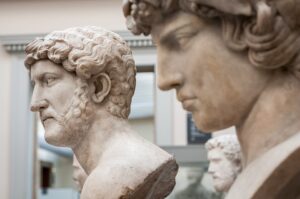
Hadrian and Antinous
But seven years, as I say, was their limit. In October 130 (and this is known),
Antinous disappeared overboard during a boat trip up the Nile. Speculation started
then, and continues to this day, on what exactly happened. It is quite possible that he
couldn’t swim: not all ancients were would-be Leanders, and Claudiopolis (modern
Bolu) is not on the sea – but then again, it is close to Lake Abant. If he was whacked
on the head by a jealous courtier, swimming might not have come into it. Suicide has
been suggested: was Hadrian getting tired of him? In The Memoirs of Hadrian,
which I dare say many of you have read, or at least have (it used to be one of the two
foreign books you could count on finding – the other was The Leopard – on every
middle-class bookshelf, especially if there was only the one shelf) Yourcenar has
Hadrian thinking the (by now) young man had ritually sacrificed himself to prolong the
emperor’s life – his health had lately been poor. Some have even suggested that
Hadrian himself sacrificed him – the one whom you most love – for the same reason.
Obviously, nobody knows, and if contemporaries hadn’t a clue we are not going to
find out now.
A correction: I say in the poem that the body was not found: I think that is wrong,
and that he was instead buried in some splendour near the Nile and a great city –
Antinopolis, no longer existent – built around his tomb by the grief-stricken – guilt-
stricken? – emperor.
Antinous’ afterlife is at least as interesting as his life. He was soon deified and a
cult sprang up around him: some thirty temples are known to have existed, though
none survive. Hadrian commissioned numerous statues, supposedly twenty or so for
his villa at Tivoli alone. Others were carved all over the empire – there are more
surviving images of Antinous than any other classical figure apart from Augustus and
Hadrian himself.
The phenomenon of deification, sometimes while still alive, is not quite as bizarre
as it sounds. As Peter Thonemann points out in his excellent little book The
Hellenistic Age, before Christianity most people had little time for all-powerful gods
who create worlds and sit in judgement; what they wanted were practical gods who
could do something for you now: cure your gout, help you beat your enemies in
battle, find a mate, or at least the car keys. In short, they were more like patron saints
– and why not?
Instead of reading the Antinous poem in Them Greeks, I thought I would offer you
this ditty from the recently published Correspondence of Anthony Hecht and William
L. MacDonald (which is incidentally a delight). It’s not actually written by either of
them,
but by a “gorgeous ex-student” of the latter:
There once was a youth named Antinous
with Praxiteles curves oh so sinuous:
he fell in the drink
and quickly did sink;
now he sleeps in the deep midst the minnuous.
When Hadrian got the bad news
he felt like a poet sans muse:
“Alas and alack
my life’s out of whack:
we should never have taken that cruise.”
As to the late lad’s continuing relevance to our own times, you will be glad to
know he has a Twitter account – @antinousgaygod. I’m afraid that even in the
interests of research, I couldn’t bring myself to ‘follow’ it – but I’m sure many of you
may wish to.
And so, finally, to Dennis the Small, sometimes Dennis the Humble, more formally
Dionysius Exiguus.
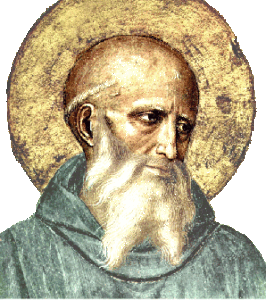
Dionysius Exiguus
Although the Romans were inclined to dismissively call anyone from ‘up there’ a
Thracian, rather as the Italians say extracommunitario, Dionysius or Dennis (b.
c470AD) did actually come from Scythia Minor on the coast of the Black Sea, and
was a bona fide Thracian. He was initially a member of a monastic community at
Tomis, where, or more correctly whither, Ovid, as you may remember, had been
banished nearly 500 years earlier. At some point on the cusp of the fifth and sixth
centuries he moved to Rome where he beavered away at translating episcopal
decrees and similarly stimulating material from Greek into Latin.
None of this would be especially compelling or poemworthy had he not made, to
some extent inadvertently, a great dating breakthrough – and I don’t mean in the
matchmaking sense. Even in Dennis’s time folk still dated events according to who
was consul in a given year, or by the various Anno Mundi, or AM, calendars, dating
events from a putative creation of the world, of which the Jewish one is currently the
best known, and still in use. There are obvious drawbacks to both systems: Jewish
palaeontology, for example, ought to be impossible. And I believe there are still
western communities of biblical literalists who insist that the fossil record is a sort of
practical joke on God’s part – or sometimes the Devil’s. In the other case, one would
have to have a prodigious grasp of consular lists for the system to be of much
practical use.
Dennis’s wheeze was Anno Domini. He dreamed up, that is, a dating system
beginning with the birth of Jesus. I believe that Jesus is now thought to have been
born a couple of years before the year zero, but that’s really neither here nor there.
Dionysius’ concerns had more to do with the dating of Easter and thwarting certain
whacky end-of-the-world expectations dependent on AM calculations, he never
himself actually used his new scheme for dating historical events. It was the
Reverend Bede who eventually popularised it with his bestselling Ecclesiastical
History of the English People.
But the real strength of Dionysius’ idea is not so much AD as BC, which I don’t
think was of great, or indeed any, interest to the tiny monk himself. That is what I
mean by ‘inadvertently’. The displaced dating systems do, after all, work up to a point
for modern centuries – the consular one is obviously hopelessly unwieldy, even if we
still had consuls, but its cousin, regnal dating – “It was in the third year of the reign of
King Wenceslas” – works after a fashion, at least for monarchies. And the Jewish
one is clearly fine for recent millenia. But the unique merit of BC is that allows you to
go backwards indefinitely without having to tie yourself in knots trying to explain how
dinosaurs managed to roam the earth long before the creation of the world. An
ostensibly simple idea, but as dramatically lifechanging as …kitchen towel.
Here, in closing, is my Dionysius poem:
Dionysius Exiguus
Let’s hear it for Dennis the Small,
who made the Nativity
a hinge for history.
But for his brainwave we’d still be
counting from the Creation,
the Pleistocene a fog,
or listing the consuls
from Lentulus
to Jacob Rees-Mogg.
Where are the street-names, statuary,
the commemorative
philately, telelectures
with toga’d extras,
the Dennises christened for Small?
It’s only thanks to the minimal Thracian
that we know when we are at all.
Chris Andrews
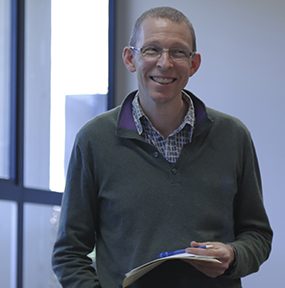
I don’t know if I am an excessively glass-half-empty person – I hope not – but it’s certainly true that I am more often disappointed than I should be with follow-ups to poetry collections I have liked. It would be unkind to cite examples, so instead why not celebrate an exception? I first came across the Australian poet Chris Andrews (b. 1962) when he won the 2011 Anthony Hecht Prize. I was a finalist myself in that competition – judged by Mark Strand – and have never been able to decide whether it is galling or consoling that Chris’s Lime Green Chair was a better book than (what would become) The Sadness of Animals. We have had to wait over a decade for another volume – Andrews has been earning his crust in the meantime teaching European literature at the University of Western Sydney and is also a prolific translator, most notably of Roberto Bolaño and César Aira (neither of whom, curiously, are European) – but at last we have The Oblong Plot, published in Australia by Puncher & Wattmann but procurable elsewhere from Amazon. And the only disappointing thing about it is the slightly inferior binding: the card covers curl too easily with use – which they are going to get.
A peculiarity of Chris Andrews’ output is that each of his three collections so far are built around a particular verse form – of his own invention, so far as I can tell. In Cut Lunch (Gininderra Press, Australia, 2002), Lime Green Chair’s only predecessor, this consists of three five-line stanzas with a sort of terza rima rhyme scheme – that is, with the middle line of each verse providing the first and last of the next – sometimes (not always) the middle line of the last stanza referring back to the outside two of the first.
Rather than having you imagine this, here is an example:
The Things You Are
You are an ill-lit archive where extinct brands
of ice-cream are filed under Lickety Split.
You’re all the hardships your ancestors came through
what you swallowed a couple of hours ago
and a set of instinctive short-cut commands.
The guy who said you’re exactly what you do
no wonder his life was a race against time
but the ones who say it’s all in how you frame
your mind sound like they’re selling unhappiness
insurance. Maybe you’re how you cycle through
these ways of thinking but there are some who say
you are still what you were before you could speak
or already what you will be in the hands
of people who won’t need to know who you are
when almost everything has been stripped away.
The stanza breaks seem there to emphasise the scheme rather than indicating any kind of break in sense or change of direction: the narrative just hurdles or hurtles over them,
And that hurtle effect – which is also evident in Andrews’ next two volumes – is reinforced by an absence of any punctuation other than the full stop (the second stanza in particular could do with the odd comma). There is another important feature here, which is less easy to notice: a pretty strict syllable count, hendecasyllables to be specific. I say ‘pretty strict’ rather than ‘strict’ only because he will award words like ‘everything’ three syllables (as indeed most people pronounce them), rather than four. I think I may leave a more extended discussion of syllabics for another day, but they are there in all three books.
I should say that there are a certain number of poems in Cut Lunch, as in Lime Green Chair and The Oblong Plot, which do not follow the given scheme. To my taste they seem marginally less successful (in all three) but I would not want to put too much weight on that.
When we reach the Hecht-winning Lime Green Chair, the rhymes have been ditched (but we get a bit of punctuation in exchange), and, although hendecasyllables still reign, there is a new stanza form: thirteen lines followed by eight. Fellow Aussie, fellow Chris, Chris Wallace-Crabbe – no mean poet himself – is quoted on the back cover claiming that the form “mockingly subverts centuries of the sonnet in English”, but it is hard to see how. Again, in defiance of Chris 2’s suggestion that the break between the 13 and the 8 constitutes a volta, the poem again as often as not vaults over the abyss without breaking stride. In this one there is, in fact, a sense break at the stanza break.
Prop
I prop up the dog and wait for him to pee.
Three a.m. A phrase goes floating through my head:
“A still Prussian-blue night with rather weak stars.”
In the dirt where summer scorched the lawn away
a puddle forms, burnt-umber summer that changed
the climate of feeling about climate change.
Weak stars because a fullish moon is climbing
into the sky like scandalous new talent
with no intention of inspiring envy,
climbing above the autumnal pergola
shedding butter- and claret-coloured vine leaves
sprung from a stock gnarled like an arthritic leg,
rotting at the core, propped up with a fence post.
Moonlight makes the puddle’s meniscus glisten.
The sky my black cab dripping from the car wash.
The Earth wobbling on through space, riddled with life,
from the thickening mothers of vinegar
to insomniacs anonymous who see
a future of unscheduled meetings with death,
from sap-green bamboo for Shanghai scaffolding
to an old dog running away in his dreams.
The pace of it leaves you quite breathless, don’t you think?
Having been responsible for (guilty of?) I fair bit of soppiness in my time, I can’t resist also giving you just the last, 8-line section of ‘My Life Without You’ – Chris in uncharacteristically romantic vein:
Next year it will be twenty years already.
You’ve probably forgotten most of the times
you made all the difference (if you ever knew)
by not being otherwise than as you are:
a perfect stranger to dinginess. You were
the barefoot breeze all along the branching path,
the breathable light and the ocean-washed air.
It was you. I knew it, I had no idea.
And so to The Oblong Plot. And to a new verse form – this time three nine-line nine-syllable stanzas (enneasyllabics, in case you wanted to know). Once more, better to show than to tell:
Under Fang
Day my colour-bound myopia,
before you go can I just say how
claret leaves cut puzzles in the blue
and what the skywriter hearted there
was anybody’s progressive guess.
Day the only place for us to park
our demountable utopia,
don’t slip away like a timid guest
before I can say just how you go.
Another brilliant day gone missing
the never-yet assembled fragments,
with nothing to guide me but the ghost
of a pattern: net trap set to catch
the matter that could make a part whole.
Rumbly bins, Venus dipping to kiss
lichen-crusted tiles, and here you are:
dusk my shot of myalgia my
shadow-flooded topiary maze.
It might be true, what my brother says:
I like to aim low. My ambition:
to remain an opsimath. Success:
not having given up just yet.
But I stand under a blown street lamp.
It’s Alphard, so my phone-eye tells me,
At the far end of the starlight thread.
Somebody watching under you, Fang.
Deep sky night my ache my opiate.
Three colons in three lines in the last stanza! – but the hurtle is still there, for all that. This is, incidentally, not the only poem to show that the young Andrews was paying attention in astronomy class.

Whereas in the previous two books the poems not following the scheme are segregated in a section of their own, here they are interspersed, and include a fun steal (acknowledged) from Raymond Queneau’s Oulipian Cent mille milliards de poèmes – in this case a sequence of nine (needless to say) nine-lined enneasyllables where – at least in theory – any line 2 can be swapped for any other line 2, 3 for 3 etc. to make more than half a million new poems (a tenth poem gives an example).. As the poet puts it: “Not all of them are less coherent than the ‘parent’ poems”. It comes as no surprise to find that Andrews’ first book was Poetry and Cosmogony: Science in the Writing of Queneau and Ponge (1999) – still apparently available from Brill at a challenging price.
But there is a lot more to Chris Andrews than tricksiness. As I said earlier, I would like to go into the subject of syllabics in English poetry at some future date; suffice it to say here that syllabic verse is a constraint – a near-Oulipian one if you like – on the poet, which the reader will most likely not be aware of. Syllabics on their own are not much use without a strong sense of rhythm – and Andrews has that in spades, if a breakneck one at times. I hope you can see/hear it in the examples above. I was going to add another favourite from The Oblong Plot, ‘The Jennifer’, but this is already quite long enough, and besides you can find it online, or, better still, buy the book.
I have forgotten, almost forgot
Doing a bit of (minimal) background research on Charles Lamb’s well-known ‘The Old Familiar Faces’ (‘why?’ is another story), I was surprised to find that he wrote this quintessentially old man’s poem when he was not quite twenty-three:
How some they have died, and some they have left me,
And some are taken from me; all are departed;
All, all are gone, the old familiar faces.
This brought to mind, tangentially, another juvenile old-man’s-poem of great beauty, it seems to me, ‘Pleasures’ by the Second World War poet Keith Douglas; this is all of it:
Forgotten the red leaves painting the temple in summer,
Forgotten my squirrel in his dark chamber,
The great turtle and the catamaran;
Rivers, where the mosaic stones are found.
That church, amputated by high explosive,
Where priests no more lift up their murmurous Latin,
And only the sun, a solitary worshipper,
Tiptoes towards the altar and rests there.
These and the hazy tropic where I lived
In tall seas where the bright fish go like footmen
Down the blue corridors about their business –
The jewelled skulls are down there – I have forgotten,
Almost forgot. How slowly they return
Like princes into the rooms they once owned. How dimly
I see the imaginary moon, the magic painter
Of wide, deserted acres with splendour and silence.
Once on Monte Nero in the spring
Some peasant girl fashioned for love and work
Taught me a smile that I had forgotten.
It is so hard to speak that language now.
Almost forgot, how slowly they return
Like princes into the halls they once owned.
– the which weepy retrospective was written at the age of eighteen, before he had even left school. Before, too, the outbreak of the war in which he would die six years later.
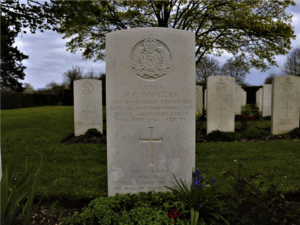
Headstone of Keith Douglas (1920-1944)
John Keats, of course, was
…“half in love with easeful Death,
Call’d him soft names in many a mused rhyme,
To take into the air my quiet breath;
Now more than ever seems it rich to die,
To cease upon the midnight with no pain…
in the spring/autumn of 1819, when he was rising 24. But he might have known, or at least suspected, that he would not see the spring or autumn of 1821
It is true, I think, that young poets are more romantically attracted to death than those of us for whom it has become a nearer prospect, and it is perhaps the case that nostalgia also becomes less appealing when it is, as it were, compulsory – when looking back is all, or most of, what’s left? I have been in the unkind habit of suggesting that most poems by young Italian aspirants are 15-30 lines long, not more than the three or four words per line, with the last line being, as often as not, “della morte”. In fairness I should say that it took a fair amount of scrolling, a couple of years back, to find the following on the excellent Internopoesia poem-a-day site (no less excellent, of course, for my having been on it a couple of times):
…E questa è gioia,
è l’attimo in cui sfioro con le dita
l’angolo del giorno,
è il suo tramonto
quando chiama a sé la sera
e mi sovviene il tempo
e la sua arsura
e con un gesto impallidito
scosto la carezza
poco prima
ben accetta
della morte.
…And this is joy,
the moment my fingers graze
the corner of the day,
and sundown
calling the evening home,
bringing time to mind,
all that it burns,
and with a pale gesture
I push away the caress
(a little earlier
all but welcome)
of death.
[more or less]
Fosca Navarra (aetas 22)
Death-embracing aside (and Fosca, I am happy to say, is still with us and has published a novel in the meantime), one of the dangers of laying out a poem this way is that it puts an unnecessary pressure on individual lines – which can struggle to bear the aphoristic weight loaded onto them – and especially the last. Hence, no doubt, short lines habitually reaching for big concepts.
Talent Scouts
Here are three paragraphs from the ‘submissions’ pages of three different publishers.
- We actively encourage diverse submissions, and would be delighted to see more poetry submitted by women, and by writers from BAME, disabled and LGBTQ backgrounds and any who have traditionally been poorly represented in poetry publishing.
- We actively encourage and welcome diverse submissions, and would love to see more poetry submitted to us by poets who are Black, Asian, mixed race or from other underrepresented ethnic backgrounds, identify as LGBTQI+, who are neurodiverse, D/deaf, disabled, working class or on a low income.
- We encourage submissions from all communities, faiths, backgrounds, and from anyone who experiences racism, ableism, poverty, homo- and trans-phobia, those under 30 years old, and from everyone else.
One thing that leaps to the eye is their similarity – do they share a copywriter, or is this an unusual subcategory of literary plagiarism?
The first example is surely the oddest. Given the number of women occupying key seats in the poetry Dress Circle, it’s odd to find them classed with the disadvantaged. What, besides, is a disabled or LGBTXYZ background? Many of the practices denoted by the more outré letters of the alphabet soup might be thought to make their champions unlikely to be providing family backgrounds for aspirant poets any time soon. And have the offspring of the disabled been “poorly represented in poetry publishing”, traditionally or otherwise? I would be mildly surprised if statistics were available.
But intriguing though these mysteries are, my question is: why have these paragraphs been inserted at all?
I would imagine that publishers, even poetry publishers, would like to shift books. Do they think that the named categories write more accomplished verse or, failing that, at least sell more of it? Perhaps the Bookseller will shortly produce some figures for 2025 poetry sales that will answer the second part of the question, but my impression was that Seamus Heaney, even posthumously, remains pretty much at the top of the charts, and he would not tick many, or any, of these talent scouts’ boxes. As to talent, you will have to answer for yourselves the first part – but, bigot that I am, I would not myself expect, say, animal rapists (Z for ‘Zoo’, in case you’re curious) to be disproportionately gifted in this (or any other) field.
There remains of course the possibility that the publishers don’t really mean it (the “and from everyone else” in the third example might hint as much), that they are just ‘virtue signalling’. But where is the virtue in promoting arbitrary non-literary groupings, and who is being signalled to?
January ’26
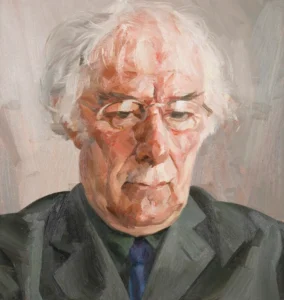
Bestselling Seamus: portrait by Tai-Shan Schierenberg (National Portrait Gallery)
LAST WEEK JORDI TORRENT, the film director responsible for my entire celluloid career (a non-speaking 20 seconds), who has clearly been reading Arthur Waley’sThe Opium War through Chinese Eyes, sent me a poetic challenge: to perform the exercise set by Lin Zexu, the better part of 200 years ago, for aspirant imperial civil servants in his charge:
On August 1oth, he summoned to a re-test sixty students, twenty from each Academy, of whom all but four presented themselves. The subject of the poem they had to write was ‘For one evening the miasmic mists by the wind have been rolled away’. The rhyme had to be ‘Han’…
And by “tomorrow lunchtime” what is more.
This was the result:
The Rhyme had to be ‘Han’
for Jordi and Flavia
“For one evening the miasmic mists
by the wind have been rolled away”
Granted that, once the fog has lifted,
what do we see? The silhouette of a man
carved into the hillside, at his wrists
and ankles rings of moss, a nosegay
of wildflowers placed by a prude
over his cock, which hasn’t been …thrifted,
shall we say – a neologism, I admit, crude,
and arguably uncalled-for, since ‘Han’
was supposed to be the rhyme.
The problem, though, is the same every time
we write poems to order: that the world
wriggles out from under us. In this case,
a sudden crosswind has slyly whirled
aloft the flowery figleaf, and the race
is on between the punctual puritan
and a returning miasma to reimpose
decorum – but still, weren’t we supposed
willy-nilly to make the rhyme ‘Han’?
of which, I have to say, I am foolishly proud, under the circumstances.
But it set me to thinking about writing to order generally. Of course, since the earliest times, poets have written – been required to write – paeans to the boss class. Horace, for one, wrote many lines in praise of Augustus, not always his best: Odes I, 2, for example, which ends “…hic ames dici pater atque princeps, / neu sinas Medos equitare inultos / te duce, Caesar.” Andrew Marvell, some centuries later, wrote (with a nod to his Roman predecessor) the rather surprising – though not wholly un-nuanced – ‘An Horatian Ode upon Cromwell’s Return from Ireland’:
…So restless Cromwell could not cease
In the inglorious arts of peace,
But thorough advent’rous war
Urged his active star.
And like the three-fork’d lightning, etc
But the practice has lapsed somewhat in recent times, except for the variable efforts of British Poets Laureate. Betjeman’s ‘Death of George V’ was perhaps not a high point in his oeuvre:
Spirits of well-shot woodcock, partridge, snipe
Flutter and bear up the Norfolk sky:
In that red house in a red mahogany book-case
The stamp collection waits with mounts long dry.
but Ted Hughes was sufficiently unashamed of his official efforts to make a book of them, Rain-Charm for the Duchy (1992) – and the title poem is at least OK, if not better than that. We will draw a veil over Amanda Gorman’s heroically bad ‘The Hill We Climb’, read, none the less, with admirable self-confidence at the Biden-Harris inauguration earlier this year.
Not all poems-to-order are political, though, and there are a number of still-flourishing genres of more intimate ‘occasional poems’ – epithalamia, birth poems, elegies, poems prompted by Catalan film-directors… – some of which, having gone on long enough today, I will have a look at next time.
20.07.2021
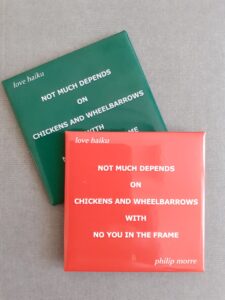
MACNEICE AGAIN. There was a tradition with some of the masters at my school that the last lesson on Saturday morning – which was the last lesson of the week – should be dedicated to reciting poems chosen at will and learned by heart, whose authors the form master had to guess. One classicist in particular, evidently not a great reader of modern poetry, would always ask tentatively of anything written post First World War: “Is it, is it MacNeeesss?”. And for a long time – still, to some extent – I too have thought of MacNeice’s ‘Snow’ (“The room was suddenly rich and the great bay-window was / Spawning snow and pink roses against it / Soundlessly collateral and incompatible…”) as a sort of emblematic modern poem. I have always had a bit of a problem, though, with the last line: “There is more than glass between the snow and the huge roses.” I feel like saying, “Well, like what, Louis?” None of the commentaries I have read supply a satisfactory answer. Similarly, I always want to ask William Carlos Williams what, exactly, “depends / upon / a red wheelbarrow etc”. Again, there are some unsatisfactory – and some wonderfully silly – answers to be found here and there on the internet. No doubt the fault is with me: I confess I have an instinctive impatience with this sort of gnomic utterance left hanging in the air. How much more admirably straightforward is Auden’s conclusion to his ‘First Things First’:
Grateful, I slept till a morning that would not say
How much it believed of what I said the storm had said
But quietly drew my attention to what had been done
– So many cubic metres the more in my cistern
Against a leonine summer–, putting first things first:
Thousands have lived without love, not one without water.
11.06.21
When we were children words were coloured
(Harlot and murder were dark purple)…
(Louis MacNeice, ‘When we were children’)
YOU MAY BE HEARING a fair amount of MacNeice over the coming months, as I’m
engaged in an attempt to get a decent Italian Selected Poems published, the 1974
Mondadori Poesie being neither well chosen nor well translated. This will obviously
entail a degree of immersion, which I’m looking forward to, having always found him
an attractive figure – a sort of Anglo-Irish Camus, I’ve often thought: both standing a
little apart from their milieu, unseduced (unlike others of their circles) by
communism, both, as it happens, what used coyly to be called “ladies’ men”, and both
dying unnecessarily before their time.
As to the coloured words, I don’t know if LM is announcing a general truth (it’s not a
childhood memory of mine) or reporting on motherless life in Carrickfergus Rectory.
Either way, ascribing colours to colourless things can be a diverting game on sleepless
nights – certainly more fun than counting sheep. For some reason I think of poetry, for
example, as bluey-green, like, say, an idealised rock-pool in a sunny country.
Just at the moment I am much obsessed with the absence of a certain person in
another continent, and that’s not easy to put a colour to. As she is gone indefinitely, I
am sometimes assailed by a traditionally black despair, but her simply not-being-there
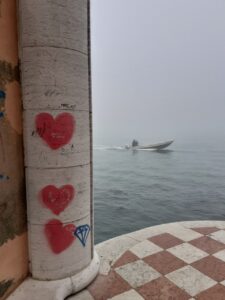
is more usually at the other end of the spectrum, like a Venetian morning mist or fog
that insinuates itself into everything. I have been seeing a lot of that lately, having
been prescribed by a mildly woo-woo gastroenterologist a sharp walk first thing
(following a cold wash and half a lemon!). Seven to eight in the morning is quite a
busy time, it turns out, on the lagoon: all kinds of craft doggedly delivering every kind
of necessity or shooting about on mysterious urgent errands, looming out of the fog
and quickly disappearing back into it…
29.03.2021
DONALD RUMSFELD AND POETRY: I often find myself mulling over DR’s much mocked but surely quite pregnant ‘known knowns’ remarks:
Reports that say that something hasn’t happened are always interesting to me, because as we know, there are known knowns; there are things we know we know. We also know there are known unknowns; that is to say we know there are some things we do not know. But there are also unknown unknowns – the ones we don’t know we don’t know. And if one looks throughout the history of our country and other free countries, it is the latter category that tends to be the difficult ones.
No doubt they were ridiculed at the time because uttered at an unlovely US Defence Department news briefing in the context of Saddam Hussein’s possession or otherwise of weapons of mass destruction, and because, well, Rumsfeld was Rumsfeld and not Plato.
He of course omitted – I doubt tellingly – the first card in the set, the unknown knowns: the things we don’t know we know, or, less positively, our ingrained assumptions – all the unexamined lumber of our minds. In a poetry context, the positive things we don’t know we know might include, say, a feeling for rhythm, or whatever it is that makes bizarre connections sprout from our minds, a facility we may even prefer to remain unexamined for fear of losing it.
The known knowns are self-explanatory: the things we know we know how to do, for example. And the known unknowns would include the things we know we don’t know how to do, the tricks we are aware of but lack: Philip Larkin wrote once to Vernon Watkins, saying something like (I can’t find the exact quote), “I wish I had your gift. If I had, I probably wouldn’t do with it what you do with it. But I wish I had it.”
But it goes without saying that the elusive golden apples are the unknown unknowns. In a sense they elude us by definition: as soon as you conceive of an unknown unknown it jumps back a category and becomes a known unknown. And it is hard to imagine what equipment you would need to go out and look for them. Perhaps it’s a fool’s errand, and we should just sit patiently out in the yard like Randall J and wait for meteorites, hoping that the odd one might be oddly shaped.
Hans Magnus Enzensberger once said to me that “Originality is overrated” and certainly I would agree that “Make it good” is a more pressing imperative than “Make it new”. Poets, or would-be poets, straining after novelty is often not a pretty sight.
But I think some part of all of us does hanker after plunging our hand into the mystical mist and coming out not with a golden apple but with some wholly unknown fruit.

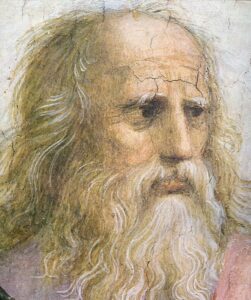
Donald Rumsfeld Plato
05.02.2021
12.01.2021
THERE WAS A TIME – do you remember? – when, were you irked by the world or one of its representatives, you would write a letter to the Times or some other organ, beginning “Sir – Am I alone in thinking….”. Having honed this missive over slightly too much grappa, you would leave it on the kitchen table for posting in the morning, at which point, reread with sobriety, it would join the eggshells in the bin. Nowadays, of course, we have Twitter. A twitch of irritation and it’s out there. That the ridiculous ex-president of the United States spews what passes for his mind over the facility is hardly to be wondered at – he’s probably not overdeft with a fountain pen – but I wish some of our fine poets would think thrice before scattering their predictable politics and virtue-signalling before us with quite such persistence. Perhaps illogically, it makes me doubt their verses. Suppose Ezra had had the opportunity – might not the Cantos be buried with him? Stay with your lathes, boys. If you must, write a letter. And throw it away.
17.11.2020
SOME VERY ODD SONGS OF PRAISE have been creeping into prize citations lately – ‘honest’ and ‘brave’ in particular occur with baffling frequency. If I think of some of my very favourite poems, ‘My Last Duchess’, maybe, or ‘They Flee from me that Sometime did me Seek’ or, to be more contemporary, Stuart Dischell’s ‘She Put on her Lipstick in the Dark’ or Robert Selby’s ‘Lady Thatcher’, it’s not that they are insincere or cowardly, but rather that such categories simply don’t apply. Did Selby ever live in a thatched house, or Dischell ‘meet a blind girl in Paris once’? I suspect in both cases not. Does it matter? Dischell actually begins his pantoum with a rather slippery ‘I really did meet a blind girl…’ which is quite possibly actually dishonest, if we take the speaker to be himself – but isn’t that rather a naïve thing to assume? We certainly don’t suppose Robert Browning to have ruled Ferrara in the 16th century and bumped his wife off (though you imagine Elizabeth could be quite irritating), or Thomas Wyatt to have had trouble pulling the girls after Anne Boleyn. Supposing Sir Thom had written “I flee from them that ofttimes do me seek” would he be disqualified for his lack of spunk? The truth is, of course, that bravery and honesty have no more to do with poetic merit than hair colour or favourite pudding. Do the distinguished judges not know this? If they think it elitist to look for skill, could they not commend, say, zip?
22.08.2018
Jay Bernard – brave 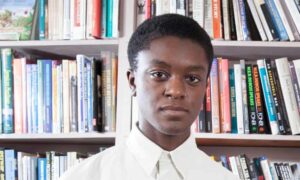
 Thomas Wyatt – not brave?
WE’VE BEEN GETTING quite high winds hurtling down our west-east canal lately, and I’ve taken to closing the shutters at night so as to be able to tilt the balcony window and let in some nocturnal air without risking its hinges. It was not, then, until pushing back those shutters this morning – and push was the word – that I found we’d had a couple of inches of settled snow overnight. I know snow’s no big deal in England where you’ve been cheerfully smashing into one another on the B-roads for a couple of weeks now; weather warnings persistently ‘in place’, in the pompous jargon of the weathermen. But here the white powder’s rarer, and pretties everything up of course, papering over the grime, making a place already given to timelessness look like a Christmas card from any decade you like. Where I am, we mercifully don’t get many tourists, so it was all children skidding to school hand-in-hand with solicitous dads (lads take, lasses collect) and dogs, not strong on memory, leaping and barking as if they’ve never before seen the stuff.We are a little out of time in other ways here too: folks, foreign residents included, tend to know each other within a sestiere – when I need to be somewhere punctually, I have to leave the house fifteen minutes early to allow for the necessary social exchanges; the newspapers, with unblushingly cheerful racism, refer to the (numerous) Chinese as “gli occhi di mandorla” (‘the almond-eyed’); the dustbinmen still come every day – yes, you filthy Anglo-Saxons, every day (except Sunday); wine can be bought sfuso (from the tap, bring your own bottle) for €2.50 a litre, from five different outlets a few minutes’ walk away (the Venetians are proverbial in the rest of Italy for their thirst). Really all we lack for is poetry, and you may think, in these days of excess, that’s not wholly to be lamented. For all the painting and music, indigenous literature has never been the Venetian forte. There’s Goldoni of course, but practically all the famous poets associated with the city have been visitors, from Petrarch through to Goethe, Pound and Brodsky. I believe Craig Raine lurks, at least intermittently, down at the other end of town. One Bartolomeo Dotti, murdered near Sant’Angelo in 1713 for his satires on those in high places, is of some interest, but even he was born in Brescia. The top wholly DOC bard is undoubtedly the highly talented – and still quite readable – cortigiana, Veronica Franco (1546-1591) – so posh a hooker was she, in fact, that when Henri III was recalled from the throne of Poland to that of France on the unexpected death of his brother Charles IX in 1574, and stopped off to be fêted in Venice along the way, part of the fêting was a night with Veronica. This might actually have been a bit of a chore for the essentially gay king, but she was, after all, a pro, and the young couple, none the worse for wear, exchanged gallant epistolary verses afterwards.
28.02.2018